

A diversified investment grade corporate bond fund. The approach is relatively conservative and there are clear guidelines with regard to relative duration positioning and the allocation to non-investment grade credit. Within its sector, the fund features in our 'Flexible' category.
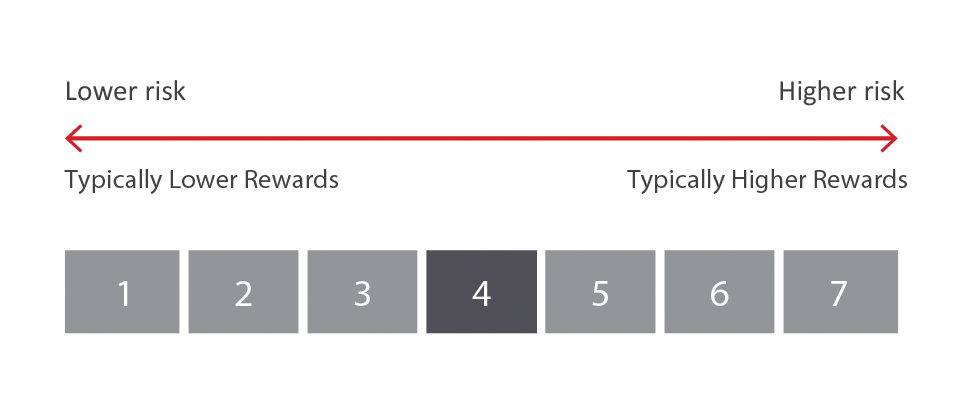
The fund’s KIID Synthetic Risk and Reward Indicator (SRRI) is 4. This is a regulatory measurement that is, where possible, calculated from the volatility of its weekly performance over a five-year period. A score of 4 means the fund’s historic volatility is between 5% and 10%.
The fund’s risk score is in keeping with the sector. We believe that the managers’ diversified approach and limited use of duration as a source of relative return should result in a volatility outcome that is in keeping with key indices. Different share classes could have differing SRRI scores.
Lead manager, Kris Atkinson, is a long-standing member of Fidelity’s fixed income team. He joined Fidelity in 2000 and became a portfolio manager in 2013. He works closely with co-manager, Mr Gohil, who joined Fidelity in 2023. He has considerable fixed income experience, having previously worked at HSBC Global Asset Management as a senior credit portfolio manager and Head of UK Credit Solutions. They are supported by an extensive fixed income team, which includes significant quantitative and credit analyst resources.
The philosophy is built upon the core pillars of bond investing. Specifically, the managers aim to strike a balance between delivering an attractive level of income, providing downside protection and offering diversification away from equities.
In keeping with the fund’s core mandate and focus on credit analysis, parameters are in place to help ensure investment grade corporate bonds are the key driver of performance. As a result, there is an internal restriction on high yield at 5% and duration (a measure of interest rate sensitivity) is typically within one year of the benchmark’s duration. Up to 30% of the fund may be held in non-sterling issuers but there is a limit of 10% on unhedged sterling exposure. The managers’ commitment to diversification means they usually hold around 200 issuers and it is unusual for one sector to account for more than 20% of assets.
The managers seek to include a wide range of inputs into a diversified portfolio. Thus, the well-resourced team looks to add value through both macro-economic and credit analysis, taking asset allocation, interest rate, sector and issuer risks. The approach is underpinned by statistical models covering valuation metrics, relative value opportunities and asset allocation preferences. These are used to inform the team’s debate through investment and portfolio strategy meetings, through which they generate macro-economic themes before selecting appropriate strategies for individual funds. Throughout this process, there is significant emphasis on the risks to their expectations and, in line with the aim of achieving consistency in the performance profile, they explore these risks and consider trades to help protect the portfolio from the most probable.
The population of the portfolio is highly dependent upon the input of the credit analysts. They build in-house financial models to inform a proprietary credit rating that reflects their assessment of a company’s creditworthiness. They make issuer recommendations to fund managers, incorporating an assessment of relative value between issuers and an understanding of broader sector trends.
Formal documentation, including the fund prospectus and the KIID, should be sought directly from the asset manager. For ease of reference, a link to the ASSET MANAGER WEBSITE can be found above.
Investment Association sector definition: Funds which invest at least 80% of their assets in Sterling denominated (or hedged back to Sterling), Triple BBB minus or above corporate bond securities (as measured by Standard & Poors or an equivalent external rating agency). This excludes convertibles, preference shares and permanent interest bearing shares (PIBs).
Read more > Your use of this website is subject to the terms of use set out in the website. By continuing to use our website we will assume that you are happy to receive non-privacy intrusive cookies. Please be aware that if you disable cookies some functionality on the site will not work. Read our cookies policy to find out more about our cookie use and how to disable cookies.
Alternatively, if you are not a financial professional and are seeking financial advice, you may wish to visit unbiased.co.uk to search for a financial adviser.