

A specialist global equity fund with a sole focus on investing in companies with high quality infrastructure assets with a view to providing 'real' income and capital growth. The approach is bottom-up, valuation driven and includes detailed stock modelling and monitoring.
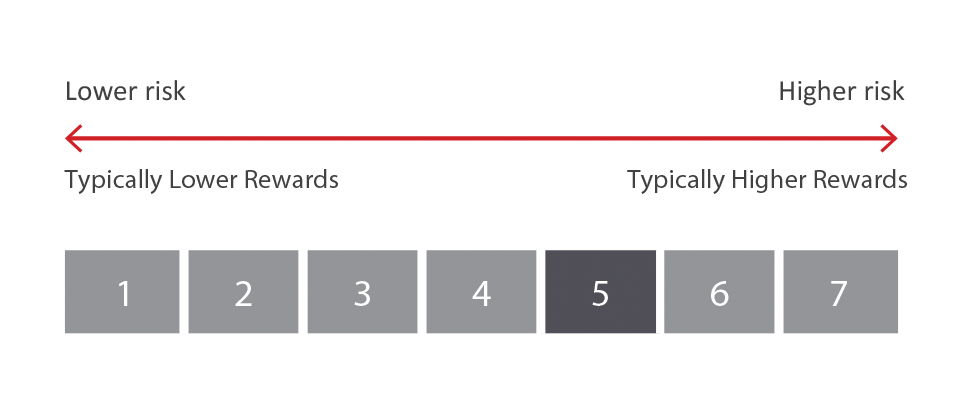
The fund’s KIID Synthetic Risk and Reward Indicator (SRRI) is 5. This is a regulatory measurement that is, where possible, calculated from the volatility of its weekly performance over a five-year period. A score of 5 means the fund’s historic volatility is between 10% and 15%.
SRRI scores of 6 and 5 are most common in this sector. An SRRI score of 5 is in keeping with that of global equities and other infrastructure equity funds. We believe this to be a fair reflection of the team’s approach. Different share classes could have differing SRRI scores.
Peter Meany is Head of Global Listed Infrastructure and co-founded the firm’s infrastructure business with Andrew Greenup in 2007. They co-manage the fund and have many years of experience in this specialist field. They are supported by a dedicated team of investment professionals and analysts.
The team seeks to deliver inflation-protected income, while aiming to preserve and grow capital over the long-term, through investing in companies with high quality infrastructure assets that are trading at a discount to their long-term fundamental value. They favour companies that have strong management teams, robust business models and assets that exhibit monopolistic traits, such as pricing power.
The portfolio typically features around 40 holdings and does not hold fewer than 20 stocks. While the fund is constructed from the bottom-up, regional and sector risks are carefully monitored by the team. This is to ensure that the fund is diversified across both countries and sectors. Individual position sizes are a reflection of the team's conviction and typically companies that rank higher on the quality and value assessment will have a greater weight in the fund. The fund may hold emerging market stocks, as long as they meet their strict investment criteria, but with an internal limit of 20% (typically this has been well below the limit).
The managers have developed a pragmatic, bottom-up, valuation-driven approach that seeks to emphasise high quality companies without over paying for these assets. Investments can be in "income" infrastructure sectors, that have steadily growing dividends, or "growth" infrastructure sectors, that can benefit from improving economic conditions or changing industry dynamics. The initial investment universe is screened to exclude companies that do not meet the team's liquidity, volatility and growth requirements. The remaining stocks, which form a focus list of around 130 securities, are then subjected to detailed fundamental analysis and are ranked according to quality and value criteria. The quality and value rankings are combined to provide an indication of the most attractive companies from the bottom-up research. The largest holdings in the fund are those that score highly on the value and quality criteria. Finally, the team considers and debates various geopolitical and macroeconomic scenarios and the potential impact on the overall portfolio.
Formal documentation, including the fund prospectus and the KIID, should be sought directly from the asset manager. For ease of reference, a link to the ASSET MANAGER WEBSITE can be found above.
Investment Association sector definition: Funds that invest at least 80% of their assets (directly or indirectly) in companies involved in the ownership, operation or maintenance of infrastructure assets (including but not limited to: utilities, energy, transport, health, education, security, communications).
Read more > Your use of this website is subject to the terms of use set out in the website. By continuing to use our website we will assume that you are happy to receive non-privacy intrusive cookies. Please be aware that if you disable cookies some functionality on the site will not work. Read our cookies policy to find out more about our cookie use and how to disable cookies.
Alternatively, if you are not a financial professional and are seeking financial advice, you may wish to visit unbiased.co.uk to search for a financial adviser.