

A diversified multi-asset fund, managed with flexibility but against the backdrop of a robust valuation framework. The fund is managed for total return, with the delivery of a growing income stream being a key feature of the process. Within its sector, the fund features in our 'Flexible Mix, Primarily Global Bonds and Global Equities' category.
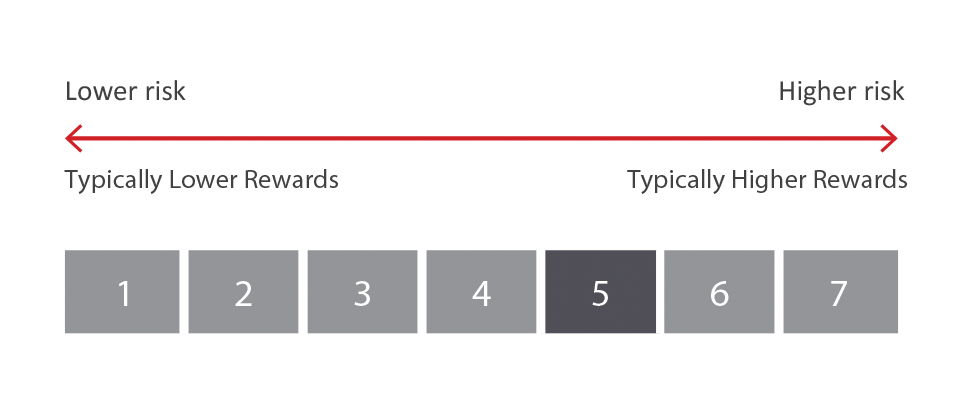
The fund’s KIID Synthetic Risk and Reward Indicator (SRRI) is 5. This is a regulatory measurement that is, where possible, calculated from the volatility of its weekly performance over a five-year period. A score of 5 means the fund’s historic volatility is between 10% and 15%.
This score is in keeping with other mixed asset funds found within the peer group. Given the manager’s valuation focused approach and willingness to be contrary, the fund can experience episodes of higher volatility and periods when its risk/return profile deviates from other mixed asset income funds in the peer group. Different share classes could have differing SRRI scores.
The fund is managed by Stefano Amato, alongside deputy managers, Maria Municchi and Will Hayes. Mr Amato joined M&G in November 2022 and was previously Head of Multi Asset Solutions at Santander Asset Management. They are part of the Asset Allocation team within M&G’s Macro and Multi Asset division, which is under the direction of M&G’s CIO Equities, Multi Asset & Sustainability, Fabiana Fedeli.
The fund is managed for total return, with the team seeking to deliver a growing level of income and capital growth of 2-4% pa, net of fees, over any three-year period, through a diversified portfolio of equities, fixed income and other assets. The team believes that no one has the edge in predicting market movements and, instead, the focus is on what current valuations are signalling about the attractiveness of different assets, and why
With a view to delivering a regular and growing income stream, portfolio exposures are biased to assets that offer a regular income, such as dividend-paying equities, corporate and government bonds. Typically, the fund is composed of 20-50% in equities, 40-80% in bonds (including emerging market debt) and up to 20% in other assets, which can include convertibles. Derivatives are used, particularly in the optimisation of the income delivery. To minimise the risk attached to specific holdings, the maximum single equity position is 1.5%, and the maximum single corporate bond position is 1%. The current and prospective income profile of the fund is monitored by a proprietary system. From a currency perspective, at least 70% of the fund’s assets is in UK sterling.
The cornerstone of the investment approach is to establish which income-generating assets appear attractively or unattractively priced, and as importantly, to understand why. There are three key stages in the process: strategic assessment, tactical assessment and portfolio construction.
The strategic assessment stage involves an objective examination of the investment universe via the team’s valuation framework. This helps them assess fair value in the light of historical expected returns, economic theories and investors’ preferences for each asset class. In their terminology, this is referred to as, “neutrality”. Then, they compare this neutrality with the real yield of these assets to create a valuation framework. Where an asset’s real yield is not in line with neutrality, the team can conclude that the current valuation is either cheap or expensive.
The next stage is tactical assessment, which introduces behavioural assessments. Here, the team seeks to identify what is driving prices; the reason could be fundamental in nature, or behavioural, where investors are reacting emotionally to events. Where the team expects a mispricing episode to correct, this could represent an opportunity for the portfolio.
At the construction stage, the manager decides how to calibrate the portfolio to best meet the fund’s return and risk aspirations. Central to this decision is the delivery of a regular, growing and diversified income stream. Individual equity holdings are identified via a quantitative process, with baskets of stocks deployed to achieve a desired market exposure. Bonds are selected based on the manager’s macro-economic views, desired yield curve position, duration exposure and appetite for credit risk. The manager also has a regular dialogue with in-house experts regarding individual stocks/bonds. For other asset classes, such as convertibles and REITs, the manager can use other M&G funds to achieve exposures.
Formal documentation, including the fund prospectus and the KIID, should be sought directly from the asset manager. For ease of reference, a link to the ASSET MANAGER WEBSITE can be found above.
Investment Association sector definition: Funds in this sector are required to have a range of different investments. The fund must have between 20% and 60% invested in company shares (equities). At least 30% of the fund must be in fixed income investments (for example, corporate and Government bonds) and/or “cash” investments. “Cash” can include investments such as current account cash, short-term fixed income investments and certificates of deposit.
Maximum 60% equity exposure (including convertibles).
Minimum 20% equity exposure.
Minimum 30% fixed income and cash.
Minimum 60% investment in established market currencies (US Dollar, Sterling & Euro) of which 30% must be Sterling.
Sterling requirement includes assets hedged back to Sterling
Your use of this website is subject to the terms of use set out in the website. By continuing to use our website we will assume that you are happy to receive non-privacy intrusive cookies. Please be aware that if you disable cookies some functionality on the site will not work. Read our cookies policy to find out more about our cookie use and how to disable cookies.
Alternatively, if you are not a financial professional and are seeking financial advice, you may wish to visit unbiased.co.uk to search for a financial adviser.