

A specialist global equity fund with a sole focus on investing in companies with high quality infrastructure assets, with a view to delivering sustainable income and capital growth over the long term. The approach is stock specific, focusing on a company's capital discipline and long-term growth potential.
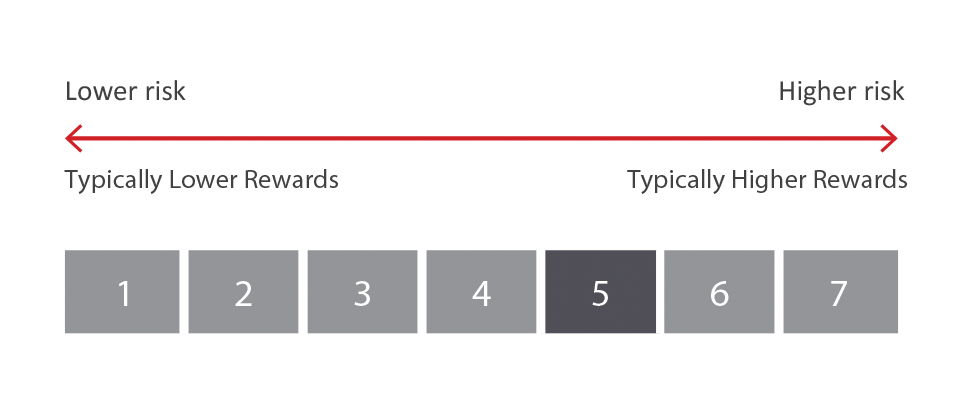
The fund’s KIID Synthetic Risk and Reward Indicator (SRRI) is 5. This is a regulatory measurement that is, where possible, calculated from the volatility of its weekly performance over a five-year period. A score of 5 means the fund’s historic volatility is between 10% to 15%.
SRRI scores of 6 and 5 are most common in this sector. An SRRI score of 5 is in keeping with that of global equities and other infrastructure equity funds. The fund’s more growth-orientated approach compared to peers means that it is typically more correlated to the broad direction of global equities than other funds with a specialist infrastructure mandate. Different share classes could have differing SRRI scores.
Fund manager, Alex Araujo, has more than twenty years’ experience in equity and listed infrastructure investment. He works closely with deputy manager, Nicholas Cunningham who joined M&G in 2019. They are both members of M&G’s Global Equity team. The Global Equity team manages a range of value, income and thematic strategies and is headed by Dan White.
The fund is managed for total return, with the manager seeking to grow investors’ capital and to deliver an income stream that increases every year (in sterling terms) through a diversified portfolio of publicly-listed infrastructure companies. The team aims to provide investors with the favourable characteristics of the asset class, while also embracing the dividend growth philosophy which is central to M&G’s Income team.
The fund is relatively concentrated, typically comprising 40-50 holdings. Each holding size is typically 1-4% of the portfolio. Although “economic” infrastructure companies are the mainstay of the portfolio (65-75%), there is the flexibility to invest up to 10-20% in “social” infrastructure and 15-25% in “evolving” infrastructure. This promotes diversification across different industries, geographies and infrastructure classes.
The bottom-up approach is focused upon a company’s capital discipline and long-term growth potential. The team deploys a customised screen to identify a broad infrastructure stock universe. To be included, companies must own or control critical physical infrastructure, long-life concessions or perpetual royalties. The emphasis on physical assets is an important distinction, as they believe it creates a strategic barrier to entry. ESG considerations are integrated into the investment process to assess the unique risks associated with infrastructure assets. Firms that derive more than 30% of their revenues from coal-fired or nuclear power are automatically screened out. In addition, the fund has no material exposure to tobacco, alcohol, adult entertainment, gambling or weapons. More detailed research is then undertaken to identify those companies with a record of raising dividends through economic cycles, capital discipline and with long-term growth potential. Their investable universe is around 250 stocks.
To promote balance in the portfolio, they select stocks from three different infrastructure categories: “economic” infrastructure companies are regarded as traditional infrastructure stocks (eg utilities, energy, transport) which deliver stable dividend growth over time; “social” infrastructure stocks have similar characteristics and dividend profiles, but are orientated to longer-term contracts that tend to be inflation-protected (eg health, education, civic); “evolving” infrastructure companies offer growth opportunities and are often found in the communication segment, hence attuned to the digital world. In assessing valuation, they are pragmatic in assessing the value of future cashflow streams, considering each business on its own merits.
Formal documentation, including the fund prospectus and the KIID, should be sought directly from the asset manager. For ease of reference, a link to the ASSET MANAGER WEBSITE can be found above.
Investment Association sector definition: Funds that invest at least 80% of their assets (directly or indirectly) in companies involved in the ownership, operation or maintenance of infrastructure assets (including but not limited to: utilities, energy, transport, health, education, security, communications).
Read more > Your use of this website is subject to the terms of use set out in the website. By continuing to use our website we will assume that you are happy to receive non-privacy intrusive cookies. Please be aware that if you disable cookies some functionality on the site will not work. Read our cookies policy to find out more about our cookie use and how to disable cookies.
Alternatively, if you are not a financial professional and are seeking financial advice, you may wish to visit unbiased.co.uk to search for a financial adviser.