

An unconstrained fixed income fund. The fund's flexible mandate allows the manager to invest across the fixed income spectrum according to the economic outlook and the investment opportunity. He is willing to express his views with conviction. Within its sector, the fund features in our 'Dynamic' category.
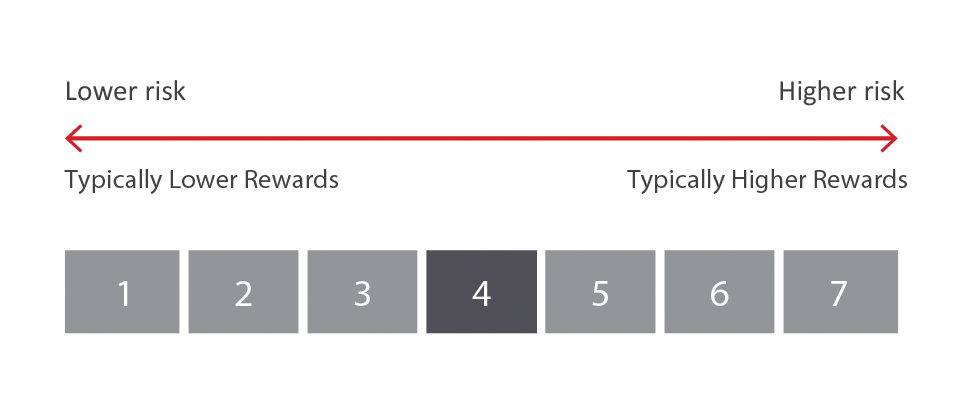
The fund’s KIID Synthetic Risk and Reward Indicator (SRRI) is 4. This is a regulatory measurement that is, where possible, calculated from the volatility of its weekly performance over a five-year period. A score of 4 means the fund’s historic volatility is between 5% and 10%.
The fund’s five year observed standard deviation is similar to that of key peers in this heterogeneous sector, although given the flexibility that is permitted in this sector, outcomes have the potential to be more variable when compared to mainstream corporate bond funds. The manager has a record of utilising the fund’s flexible mandate to adjust portfolio allocations through time, meaning that investors should be prepared for shifting portfolio characteristics. Different share classes could have differing SRRI scores.
Lead manager and Co-Head of Macro Fixed Income, Richard Woolnough, began his career in 1985 and joined M&G in 2004. He works closely with fund manager, Ben Lord, who is lead manager of the M&G UK Inflation Linked Corporate Bond fund. Stefan Isaacs, Deputy CIO of Fixed Income, is the deputy fund manager. They benefit from the resources available within the wider team, including a large team of public credit analysts.
The manager believes that he can outperform the individual bond sectors over time through a flexible approach, in which he allocates to different parts of the market according to his economic expectations. He aims to invest in assets that, in aggregate, provide the most attractive, or ‘optimal’, income stream to their owners. The income streams available vary greatly in longevity and certainty; however, they can all be characterised by the combination of duration and credit risk that they offer.
The mandate is deliberately broad to allow the manager the flexibility to position the portfolio with conviction according to his economic outlook. In principle, he can invest up to 100% of assets in each of government bonds, investment grade corporate bonds or high yield bonds, but in practice, the portfolio typically incorporates a mix of fixed income asset types. He can also invest up to 20% in contingent convertible debt (CoCos) and asset-backed securities (ABS). Individual investment grade issuers are limited to 5%, with high yield issuers capped at 3% each. Derivatives can be used for investment purposes, efficient portfolio management and hedging. In line with IA sector guidelines, at least 80% of the fund must be hedged to sterling.
The manager's macroeconomic analysis is the key input to the process, insofar as he seeks to identify the most likely medium-term economic scenario, which determines the fund's interest rate sensitivity (duration), yield curve and credit quality strategies. He reaches his views through fundamental analysis of global growth indicators, inflation statistics and other macroeconomic variables. This research also generates preferences for different parts of the fixed income market, from government bonds to high yield bonds.
The selection of individual bonds for the portfolio is dependent upon the credit analyst team's rigorous issuer analysis. This internal credit-rating and monitoring process incorporates industry research, company balance sheet analysis and stress testing. The approach often includes company meetings. The analysts are also responsible for regular, comprehensive sector reviews to support their relative value recommendations. Formal, comprehensive sector reviews take place twice a year. These are conducted on an interactive basis, providing the manager with insight into the prospects for all market sectors. When the manager has identified companies in which to invest, the flexible nature of the mandate allows him to consider the most attractive way to implement a position, in conjunction with his economic outlook and the relative value within each company's capital structure. He can make use of a broader range of investment instruments and techniques, including derivatives alongside physical assets.
Formal documentation, including the fund prospectus and the KIID, should be sought directly from the asset manager. For ease of reference, a link to the ASSET MANAGER WEBSITE can be found above.
Investment Association sector definition: Funds which invest at least 80% of their assets in Sterling denominated (or hedged back to Sterling) fixed interest securities.
Read more > Your use of this website is subject to the terms of use set out in the website. By continuing to use our website we will assume that you are happy to receive non-privacy intrusive cookies. Please be aware that if you disable cookies some functionality on the site will not work. Read our cookies policy to find out more about our cookie use and how to disable cookies.
Alternatively, if you are not a financial professional and are seeking financial advice, you may wish to visit unbiased.co.uk to search for a financial adviser.