

A diversified investment grade bond fund with a strong focus on credit selection. The manager seeks to generate attractive relative performance, whilst also ensuring the fund retains the basic characteristics of the investment grade bond asset class. Within its sector, the fund features in our ‘Dynamic’ category.
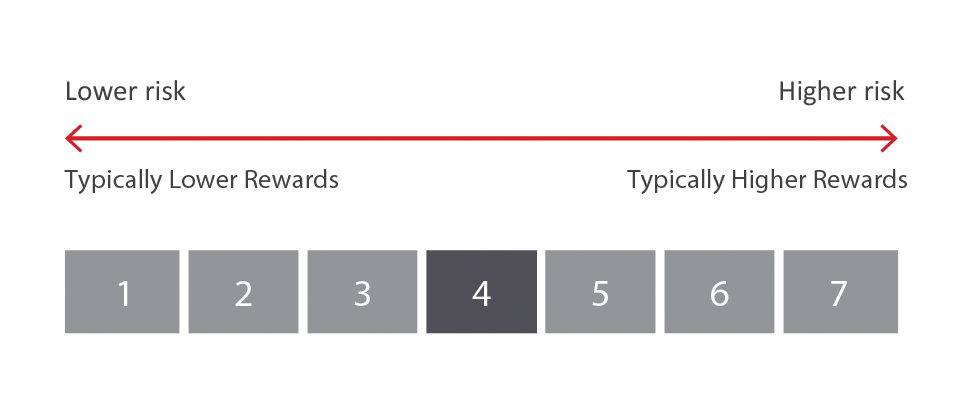
The fund’s KIID Synthetic Risk and Reward Indicator (SRRI) is 4. This is a regulatory measurement that is, where possible, calculated from the volatility of its weekly performance over a five-year period. A score of 4 means the fund’s historic volatility is between 5% and 10%.
The fund’s five-year standard deviation is broadly in-line with corporate bond indices. This is in keeping with our qualitative assessment that it offers broad exposure to the asset class, while being managed in a relatively conservative manner. Different share classes could have differing SRRI scores.
TwentyFour Asset Management is a specialist fixed income manager and a boutique business of the Swiss-based Vontobel Group. Lead manager, Chris Bowie, joined the firm as a partner in September 2014 and leads the Outcome Driven team. He works closely with co-manager, Gordon Shannon, and they are supported by junior portfolio managers, Jack Daley and Jonathan Owen. Chairman and partner, Graeme Anderson, is also a member of this team.
The managers aim to deliver attractive risk-adjusted returns with a competitive level of income, whilst maintaining the basic characteristics of an investment grade corporate bond fund. They expect the main contributor to performance to be credit selection, with more moderate contributions from asset allocation and interest rate management.
At least 80% of the fund is allocated to investment grade bonds and up to 20% may be invested in high yield bonds. The fund will not invest in non-rated bonds. The managers' aim to ensure the fund's broad risk characteristics are in keeping with the investment grade corporate bond asset class explains why duration is usually within 2 years of the benchmark level. The manager can use index derivatives to manage interest rate and credit exposure. Non-sterling exposures are hedged back to sterling.
The monthly investment committee meeting, at which the firm's macro strategy is formulated, is a key input into the process. All members of the investment team are invited to join the meeting and they review and debate a range of indicators (such as economic fundamentals, market technicals, sentiment, valuations and risk and stress analysis), whilst also covering global political issues and central bank action. Decisions are formulated on a consensual basis, with the aim of stimulating a wide-ranging and inclusive discussions. The formal process sits alongside the less formal process of regular discussions of views amongst the investment team desks.
The asset allocation and macro-economic conclusions are then applied, as appropriate, to individual funds. With this framework in mind, proprietary credit analysis is carried out by the specialists in the firm, although they also draw upon valued external research. In addition, the team makes extensive use of a proprietary research database, "Observatory", of which Mr Bowie was the key architect. The Observatory system seeks out the most compelling securities from a relative value standpoint by regressing years of historical data and combining this with variables such as yield, price volatility, sector spreads and carry. The tool is extremely flexible and can filter the credit universe in many different ways to locate bonds that satisfy the team's criteria and offer the best risk/return characteristics.
Formal documentation, including the fund prospectus and the KIID, should be sought directly from the asset manager. For ease of reference, a link to the ASSET MANAGER WEBSITE can be found above.
Investment Association sector definition: Funds which invest at least 80% of their assets in Sterling denominated (or hedged back to Sterling), Triple BBB minus or above corporate bond securities (as measured by Standard & Poors or an equivalent external rating agency). This excludes convertibles, preference shares and permanent interest bearing shares (PIBs).
Read more > Your use of this website is subject to the terms of use set out in the website. By continuing to use our website we will assume that you are happy to receive non-privacy intrusive cookies. Please be aware that if you disable cookies some functionality on the site will not work. Read our cookies policy to find out more about our cookie use and how to disable cookies.
Alternatively, if you are not a financial professional and are seeking financial advice, you may wish to visit unbiased.co.uk to search for a financial adviser.